The Times. 1993
VISIT VIDEO
Business Life Magazine. 1994
Here is another article. This one is from the Business Life Magazine in 1994. It is worth mentioning that the norm, at the time, in corporate society was to have a video conference suite. The codecs and protocols that I had developed were compatible with these.
Here is another article. This one is from the Business Life Magazine in 1994. It is worth mentioning that the norm, at the time, in corporate society was to have a video conference suite. The codecs and protocols that I had developed were compatible with these.
Today, we all think of video communication from our phones and computers as normal. But it has a long history.
It started earlier than most people know. Even searching the internet the history is lost. The general opinion is it started in 1999 when Microsoft launched MSN Messenger. But I delivered a product 6 years before that called VISIT. It was launched in Earls Court in London in 1993.
This was a World changing event. The VISIT product had all the features we look for in today's collaboration products. We brought people together for meetings without the need for travel long before it became fashionable, or required due to a global pandemic.
I developed an application with an intuitive user interface and codecs to enable true global communication mixing PCs and Macs, 64kbit and 56kbit into a single product. I made the first transatlantic video call from the UK to the USA despite me using a Mac on 64kbit ISDN and the remote user using a PC connected via switch 56. Any speed above these that were available at the time were also supported including aggregating connections.
Incidentally, that's me on the poster
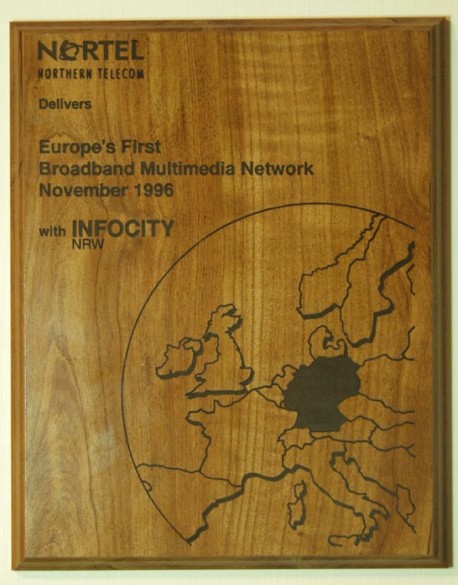
InfoCity 1996
Europe's First Multimedia Broadband Network : 1996
I developed a range of Hybrid Fibre Coax technology that enabled a return path to be added to cable TV networks. This was combined with additional bespoke hardware to distribute signals off the network and extend to users who weren't even customers o the TV network. I was able to connect anyone in the Cable TV networks are using proprietary powerline technology.
Digital Powerline : 2003
I continued my work with digital powerline technology.
This was a very fundamental technology. I surveyed many of the worlds power distribution networks analysing their characteristics. I then developed hardware that could bridge the various low frequency, high voltage, high power and noise laden networks to carry low power high frequency signals long distances and around people's homes and businesses.
This was a combination of hardware, including new silicone, and software protocols to produce a robust, reliable product.
Today, many of the home networking products people are buying off the shelf, contain the silicone and protocols I developed.
The work required to achieve this may surprise some. Particularly where the hardware was concerned. I did everything from laying out the internals of the silicone, to creating lightning to test the real-world performance.